Saturday, February 23, 2019
The No Blog Blog
THis weekend, you need to hit your research hard. Notes need to be constructed, but more importantly, you need to get your thoughts together. Post here your thesis statement, and tell us a little bit about your argument. What do you know so far? DO NOT FALL BEHIND ON THIS ASSIGNMENT. I WILL NOT ALLOW ANY LATE PAPERS!

Friday, February 15, 2019
Sir Thomas More
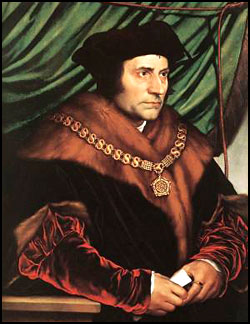
| Hans Holbein the Younger. Sir Thomas More. © Frick Collection, New York |
Sir Thomas More's Speech at his Trial.
[1535]
If I were a man, my lords, that did not regard an oath, I need not, as it is well known, in this place, at this time, nor in this case to stand as an accused person. And if this oath of yours, Master Rich, be true, then pray I that I may never see God in the face, which I would not say, were it otherwise to win the whole world.
In good faith, Master Rich, I am sorrier for your perjury than for mine own peril, and you shall understand that neither I nor any man else to my knowledge ever took you to be a man of such credit in any matter of importance I or any other would at any time vouchsafe to communicate with you. And I, as you know, of no small while have been acquainted with you and your conversation, who have known you from your youth hitherto, for we long dwelled together in one parish. Whereas yourself can tell (I am sorry you compel me to say) you were esteemed very light of tongue, a great dicer, and of no commendable fame. And so in your house at the Temple, where hath been your chief bringing up, were you likewise accounted. Can it therefore seem likely to your honorable lordships, that I would, in so weighty a cause, so unadvisedly overshoot myself as to trust Master Rich, a man of me always reputed for one of little truth, as your lordships have heard, so far above my sovereign lord the king, or any of his noble counselors, that I would unto him utter the secrets of my conscience touching the king's supremacy, the special point and only mark at my hands so long sought for?
A thing which I never did, nor ever would, after the statute thereof made, reveal unto the King's Highness himself or to any of his honorable counselors, as it is not unknown to your honors, at sundry and several times, sent from His Grace's own person unto the Tower unto me for none other purpose. Can this in your judgment, my lords, seem likely to be true? And if I had so done, indeed, my lords, as Master Rich hath sworn, seeing it was spoken but in familiar, secret talk, nothing affirming, and only in putting of cases, without other displeasant circumstances, it cannot justly be taken to be spoken maliciously; and where there is no malice there can be no offense. And over this I can never think, my lords, that so many worthy bishops, so many noble personages, and many other worshipful, virtuous, wise, and well-learned men as at the making of the law were in Parliament assembled, ever meant to have any man punished by death in whom there could be found no malice, taking malitia pro malevolentia: for if malitia be generally taken for sin, no man is there that can excuse himself. Quia si dixerimus quod peccatum non habemus, nosmetipsos seducimus, et veritas in nobis non est. [If we say we have no sin, we deceive ourselves and the truth is not in us.] And only this word, "maliciously" is in the statute material, as this term "forcibly" is in the statute of forcible entries, by which statute if a man enter peaceably, and put not his adversary out "forcibly," it is no offense, but if he put him out "forcibly," then by that statute it is an offense, and so shall be punished by this term, "forcibly."
Besides this, the manifold goodness of the King's Highness himself, that hath been so many ways my singular good lord and gracious sovereign, and that hath so dearly loved and trusted me, even at my first coming into his noble service, with the dignity of his honorable privy council, vouchsafing to admit me; and finally with the weighty room of His Grace's higher chancellor, the like whereof he never did to temporal man before, next to his own royal person the highest office in this whole realm, so far above my qualities or merits and meet therefor of his own incomparable benignity honored and exalted me, by the space of twenty years or more, showing his continual favors towards me, and (until, at mine own poor suit it pleased His Highness, giving me license with His Majesty's favor to bestow the residue of my life wholly for the provision of my soul in the service of God, and of his special goodness thereof to discharge and unburden me) most benignly heaped honors continually more and more upon me; all this His Highness's goodness, I say, so long thus bountifully extended towards me, were in my mind, my lords, matter sufficient to convince this slanderous surmise by this man so wrongfully imagined against me....
Forasmuch, my lord, as this indictment is grounded upon an act of Parliament directly oppugnant to the laws of God and his holy church, the supreme government of which, or of any part thereof, may no temporal prince presume by any law to take upon him, as rightfully belonging to the See of Rome, a spiritual preeminence by the mouth of our Savior himself, personally present upon the earth, to Saint Peter and his successors, bishops of the same see, by special prerogative granted; it is therefore in law amongst Christian men, insufficient to charge any Christian man....
More have I not to say, my lords, but that like as the blessed apostle Saint Paul, as we read in the Acts of the Apostles, was present and consented to the death of Saint Stephen, and kept their clothes that stoned him to death, and yet be they now twain holy saints in heaven, and shall continue there friends forever: so I verily trust and shall therefore right heartily pray, that though your lordships have now in earth been judges to my condemnation, we may yet hereafter in heaven merrily all meet together to our everlasting salvation.
Sunday, February 10, 2019
Finish Frankenstein
So I realized last night after a few emails that the blog I posted Thursday did not actually post. Since you have a nice chunk of time available, I am going to email you week 3 questions so you can get them done by Wednesday. If for some reason you cannot do that, you can see me for an extension until Friday. No blog today.
Friday, February 1, 2019
Epideictic Rhetoric
Write a 250-500 word tribute. It can be for a favorite historical figure or almost anything else, a book, a pet, or even a special pair of sneakers! Choosing friends or loved ones is unadvised as it is too raw for the classroom. It is best to stick with something less near and dear.
https://www.write-out-loud.com/tribute-speech.html This can offer you some help, but we are being a little more creative than this. It might be helpful, however, if you don't know where to start.
When commenting, be sure that you do not simply tell the writer they did a "good job". We need to move beyond that and into real criticism, (not to be confused with criticizing in only negative ways). You need to offer a critique. Speak intelligently is regards to their choice of diction and syntax. Comment on the writers ability to make the piece beautiful. Did he or she establish ethos? Did he or she appeal to pathos and logos? Your post is worth 10 points and each comment is worth 5. Make sure you think about your comments.
Notice the virtues that you are praising. Are they culturally defined, or are they virtues per se? Why are you praising them? Are they virtues that are in jeopardy? Would it make sense to praise virtues that are perfectly established, that there is no doubt about? Pay attention to that as you compose your tribute!
Friday, January 25, 2019
Rime of the Ancient Mariner
PSA-Check your email for week one Frankenstein Questions
Choose an essay topic. Once a topic has been chosen 3 times, it is closed.
Choose an essay topic. Once a topic has been chosen 3 times, it is closed.
- 1.Make a case for why the Ancient Mariner stops and tells his tale to the Wedding Guest of all people. In your analysis, consider the Hermit, to whom the Ancient Mariner tells his tale for the first time.
- 2.How does Coleridge use Christian and/or Biblical references to weave a moral into "The Rime of the Ancient Mariner"? Is the moral itself Christian? Why or why not? Be sure to use at least two of the following categories of evidence in your analysis: symbolism, setting, numbers, baptism, crucifixion, original sin.
- 3.How does Coleridge portray the natural world before and after the Ancient Mariner shoots the Albatross? Is there a major change? Use evidence pertaining to symbolism, metaphor, and rhyme scheme to support your thesis.
- 4.In your opinion, is the Ancient Mariner's punishment for killing the Albatross fair? Whose fate is worse, the Ancient Mariner's or the sailors'? Why?
- 5.Give at least three examples of liminal spaces in "The Rime of the Ancient Mariner" and analyze their significance, if any, to Coleridge's ultimate message to the reader.
- 6.Discuss Coleridge's use of imagery throughout "The Rime of the Ancient Mariner". How does he use sight, hearing, touch, taste, and smell to inform the reader's experience of the story? Which senses do you think he emphasizes the most, and why?
- 7.Analyze the importance of the First Voice and Second Voice. To what realm do they belong, the physical or metaphysical? Why do you think Coleridge includes their points of view in the poem?
- 8.Choose one of the following pairs of characters and analyze the similarities and differences in how they are portrayed and what role they serve: the sailors and the Albatross, the Hermit and the Wedding Guest, the Hermit and the Ancient Mariner, Life-in-Death and the spirit that loves the Albatross.
- 9.Why do you think the Ancient Mariner kills the Albatross? Do his actions make him unusually cruel, or do they connect him to the whole of humanity?
- 10.Give varying examples of instances in which someone or something is imprisoned and explain how each contributes to a larger message. Is there any instance in which someone or something that imprisons is then imprisoned, or vice versa?
- 11.Analyze "The Rime of the Ancient Mariner" as an allegory for one of the following, using points of evidence from each of the poem's seven parts: the writer's purpose, the need for spiritual salvation, environmentalism and/or animal rights.
- 12.Which do you think is the more significant motivating force in "The Rime of the Ancient Mariner": consequence, or coincidence? Make a case for one or the other using key moments of change in the plot as evidence.
Friday, January 18, 2019
Dear Mr. President or Dear Madam Speaker
So we have talked a lot over the past week about building a wall, not building a wall, polarization, compromise and ethics in politics. Our grown-ups are at a standstill, so we are respectfully writing as well-informed young people to offer support and encouragement about how the issue might be approached in a less polarizing way. You may write your letter to either the President or to the Speaker of the house. Do your very best. Use resources. Think, "what would Aristotle think of this letter?" Work hard on it.
Thursday, January 10, 2019
Build a Wall, Yea or Nay!
Groups,
We will end up with two groups for each argument. You need only post one per group. Before you submit, make sure you include a title that indicates whether you are for or against building the wall. Additionally, include all the the names of those in your group at the beginning. Be sure that your argument for either building or not building the wall is NOT POLARIZING! Stick to the directives spelled out by Monsignor Charles Pope at the conclusion of the article.
http://www.ncregister.com/blog/msgr-pope/is-there-a-catholic-view-on-the-border-wall
This might help too:
https://www.youtube.com/watch?v=J8FY4roMqmQ&app=desktop
You can use additional resources if you would like. Do not be afraid to use some of the scriptural and CCCC links in Msg. Pope's article.
Subscribe to:
Posts (Atom)